Blogmaster

If you wish to communicate with me about steam train jigsaws and/or related railway art, or to respond to requests for answers to my queries, please email David, at : platt.precology@gmail.com

Saturday, 30 October 2010

Scottish Locomotives

Somewhat neglected in the steam railway jigsaw market are those examples depicting locomotives representing the superb Scottish railway companies - The Caledonian Railway, The Highland Railway, The Glasgow and South Western Railway and the North British Railway for example. Two such jigsaws in my collection are titled Caledonian Railway 123 at Carstairs and Clan Fraser - LMS.
The first is a fine 400-piece jigsaw from the Rail Journey series by KG Games. Featured is the handsome 4-2-2 locomotive, No.123, exhibiting superb engineering qualities complemented by the famous 'Caley blue' livery. The picture appears to be reproduced from a photograph. Designed by Dugald Drummond in 1886 and built by the Glasgow company of Nielson & Co. in around 67 days, CR No.123 achieved immortality during the summer 'Races to the North' between East and West Coast Railway Companies, in 1888. In the races, she ran the final Carlisle - Edinburgh leg for the West Coast every day - a fantastic achievement. She has survived into preservation in her native Scotland.

When considering steam railway jigsaw puzzles of the rural setting type, one of my favourites is Clan Fraser - LMS reproduced from an original George Heiron painting. The 300-piece puzzle from the Falcon Steamtrains series depicts the ex-Highland Railway 4-6-0, No.14763 (previously Highland Railway No. 51) designed by Christopher Cumming. The locomotive is shown in her post grouping livery (LMS Red?) heading an Inverness to Perth express. The setting is the picturesque Inverness to Perth line.

Saturday, 23 October 2010

'Coronation Scot'

For today's post (23rd October 2010), I am focusing on a special express train, the 'Coronation Scot', as depicted in just three of many jigsaw puzzles.


The first pic shows a puzzle full of impact, Coronation Scot, a 500-piece example from KG Games. The close up view of a streamlined Stanier 'Pacific' locomotive No.6220 Coronation, in blue and silver livery and 3/4 elevation, can be compared/contrasted directly with the expansive trainshed of a huge mainline station. The train wins easily relegating the terminus to a minor role. The artist is not named.

Pic number two shows a picture from the famous railway artist David Weston. I know of only two of David's railway paintings, and they are certainly not his best, that have been reproduced in the jigsaw trade - as half of the 200-piece Steamtrains series by Falcon. The better one, Coronation Scot-LMS, shows a 'Coronation' class 4-6-2, in red (crimson lake) and gold livery, hauling the famous express. The backdrop is heavy industry (blast furnaces?) emitting what appears to be a 'golden glow'. The famous express, subdued lighting and heavy industry combine to make a memorable, but small, jigsaw puzzle.

I must admit that the jigsaw shown in the third and final pic is a bit of an enigma to me. Does it depict the 'Coronation Scot' as sent to the USA for the 1939 World Fair? No.6229 Duchess of Hamilton masqueraded as 6220 Coronation for the trip. Pictorial Publications (Leeds) Ltd., under the Grafton Major label, produced the 400-piece jigsaw titled British Express. A bell and headlamp are clearly shown in the puzzle - American adaptations. However, the locomotive, seven coaches and a first class sleeping car that were sent to America were liveried in crimson lake and gold, not blue and silver as in the puzzle. The name plate is also a long example much like City of xxxxxx  or Duchess of xxxxxxx. So the jigsaw and its title mystifies me. Can anyone shed any light?

Monday, 18 October 2010

Father of Railways

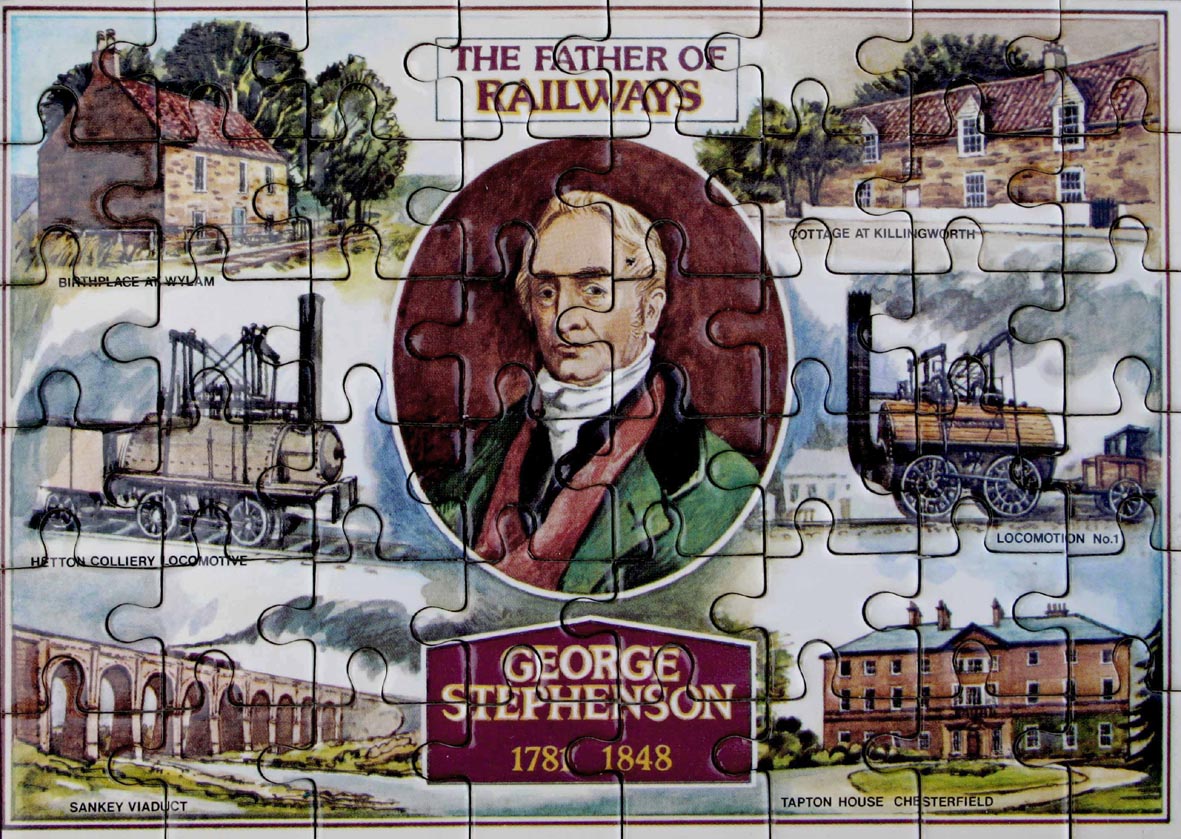
A rather special little puzzle is the subject of today's post (18th October 2010). It celebrates the life of one of the greatest engineers of the railway world, George Stephenson. 
Titled The Father of Railways it is a 48-piece example commemorating this extraordinary man who began working with his father, at Dewley Collliery in north east England, when he was 14. At 19 he was building his first railway at nearby Hetton Colliery. The rest, they say - from locomotives Locomotion No.1 (Stockton & Darlington Railway) to Rocket (Liverpool & Manchester Railway) - is history. Surrounding a central, oval portrait of George Stephenson are the following – his birthplace at Wylam, Northumberland; later residences at a cottage at Killingworth and Tapton House, Chesterfield; a Hetton Colliery locomotive; Locomotion No.1; Sankey Viaduct. Both artist and manufacturer are unknown to me. Although historical in context and highly collectible, this puzzle is extremely small. My copy is in a wrapper, not a box. If anyone has any information about this puzzle please let me know (email address above). In my view, more puzzles should be dedicated to the work of George and Robert Stephenson. This remarkable father and son duo were responsible for much of the civil and mechanical engineering involved in the birth of railways from the early 19th century.


For interest I have also added my pics of Stephenson's statue and plaque which both stand at the National Railway Museum in York - taken in 2009. The former can be seen in the Great Hall, the latter on an outside wall.


Wednesday, 13 October 2010

Chad Valley 'Cut-Out' Style Jigsaws

For this new post, 13th October 2010, I have chosen to include two photographs of jigsaws, both in the popular 'cut-out' style championed by Chad Valley in the 1920's and 1930's.

The first shows 'King' class 4-6-0, No.6000 King George V. I have this puzzle, in both of the manufactured versions, in my collection - 200 pieces and the more valuable 300 pieces. The jigsaw is simply titled King George V; the artist/photographer is not named. The pic shows the 200-piece puzzle featuring the locomotive, without the commemorative bell presented by the Baltimore and Ohio Railroad Company, following a successful visit, in 1927.


The second pic shows 'Castle' class 4-6-0, No.4073 Caerphilly Castle. This puzzle, titled Speed, is of 150 pieces and shows the locomotive travelling at great speed, in almost front elevation, heading GWR passenger stock. Although the original artwork is in a strong illustrative style, the artist is not named on the jigsaw.

Charles Collett designed both locomotives. The giant 'Kings', sometimes known as 'Super Castles', came into service between 1927 and 1936; all 31 were built at Swindon Works. The 'Castles, one of the most successful locomotive designs of all time, came into service between 1923 and 1950; 171 were built, all at Swindon Works.

Sunday, 3 October 2010

Exeter and Birmingham

The two puzzles in this latest post (2nd October 2010) show GWR stations, Exeter St Davids and Birmingham Snow Hill, as superb backdrops.

Exeter St Davids, a 1000-piece puzzle in Gibson's Heritage series, is reproduced from a Chris Woods' painting. Converted 'Star' class 4-6-0 locomotive No.4056 Princess Margaret is pictured reversing onto 'Castle' class 4-6-0 No.7029 Clun Castle to double head a passenger train to Plymouth. The 'Star' class locomotives were designed by G. J. Churchward. Clun Castle is preserved at Tyseley Locomotive Works in Birmingham. Beside these fine GWR locomotives, gas turbine locomotive No. 18100 races through the station heading another passenger train. This locomotive was actually ordered by the GWR in the 1940's but delayed by World War II. It was withdrawn from service in 1958 and was converted shortly afterwards to the prototype electric locomotive E1000. Renumbered again in 1959 to E2001, the locomotive was finally withdrawn from service in1968.


Birmingham Snow Hill Station is featured in a jigsaw from W. H. Smith titled, rather oddly, Brockhouse Station. The original painting is by John Austin who told me that the publishing company that supplied his artwork for jigsaw manufacture misinterpreted advertising signs at the station (clearly seen in the jigsaw picture) as the station name, hence the wrong jigsaw title. Two of Charles Collett's finest are depicted, a 'King' class 4-6-0 locomotive* travelling into the station whilst another, 'Castle' class 4-6-0 No.5072 Hurricane, waits in a nearby platform. Both locomotives are heading GWR chocolate and cream passenger stock.
Young trainspotters, clearly seen on the foremost platform in each puzzle, are an integral component of both.

*Thanks to Glyn Roberts for this information

Thursday, 26 August 2010

Three favourites

I have many favourites among my collection of steam railway jigsaw puzzles and here are three photographs showing less expensive examples.

The first pic features a 400-piece Mercury (Tower Press) puzzle from the 1950's/60's titled Getting Up Steam. This is a real 'in your face' puzzle of vibrant colours. It features a 'Britannia' class 4-6-2 locomotive No.70020, Mercury, heading passenger stock through a station, on a central line. On the left, on the adjacent line, a 'County' class 4-6-0 No. 1015, County of Gloucester, stands at a platform-based water tower. A railwayman stands between the two locomotives. Overhead, a 'Standard' tank engine pulls a mixed freight train over a bridge, towards a signal gantry. Boxes and milk churns add to the busy station ambience as a porter pushes a luggage trolley on the opposite platform. The artwork is not signed unfortunately, but the strong illustrative style, is superb and ideal for jigsaw puzzles.

Sir Nigel Gresley's 'A4' class locomotives were very popular with both artists and jigsaw puzzle manufacturers. C.J. Ashford's illustration of The Talisman express (introduced by the LNER in 1956) was used by Tru-Cut for a 260-piece jigsaw in the Modern Travel series. Titled The Scottish Express the locomotive No.60024, Kingfisher, is pictured sporting the early BR (1948-56) lion and wheel motif on its tender. The train is composed of carmine and cream passenger stock and is pictured exiting Kings Cross station, destined for Edinburgh Waverley.


My final picture shows a puzzle from an excellent Chris Nevard photograph that exemplifies the harmonious interaction of railway and landscape. The untitled puzzle from Fame Puzzles of Holland features a class 'U' Maunsell 2-6-0, No.1618, complete with white Southern Railway (SR) route discs. The loco is hauling SR and Pullman stock through a beautiful glade of blubells on a preserved railway. The locomotive is preserved by The Maunsell Locomotive Society.


Tuesday, 10 August 2010

Circular Puzzles

Circular puzzles always attract more attention than those of a more conventional shape, whether they are straight reproductions of paintings or montages of several paintings. Unfortunately, in my thematic jigsaw collection depicting steam railways, I have very few examples of a circular shape.

Here are two, however, and the first one shown is a favourite in my collection - a Waddington's 500-piece jigsaw from the 1950's. The montage style puzzle comprises five different express trains, all displaying famous headboards. They are pictured in separated, equal segments within a circle; they are 'Flying Scotsman', 'Golden Arrow', 'Royal Scot', 'Yorkshire Pullman' and 'Cornish Riviera Express'. Its shape places it in a minority class immediately and always invites attention, accompanied by head and neck contortions when viewed. The artist is unknown to me.

A Malcolm Root original painting was used as the source for the second circular jigsaw - a 500-piece straight reproduction example from King International. The puzzle depicts a bridge carrying a steam train over a busy high street. The locomotive appears to be one of Sir William Stanier's large 2-6-4T tank types built from 1934. An interesting feature of the puzzle is that the double-decker bus carries a destination that includes 'SHOEBURY COMN'. Before she was broken up for scrap, Shoeburyness shed was the last home for tank engine, 42516, featured in the puzzle. A bus, lorry, car and people all vie for space beneath and around the bridge, in the bustling town centre of Southend-on-Sea.

Tuesday, 3 August 2010

Three from Victory

The humble origin of Victory, one of the best loved of all jigsaw manufacturers, lies in a Dorset garden shed. Here, Gerald Hayter cut wooden puzzles for around ten years from c1920. He then rented a workshop in Bournemouth before establishing a business in Boscombe, from where Victory wooden jigsaw puzzles became a household name. For an extensive history of the company, including the complicated nomenclature and numbering systems employed, two books published by Brian P. Price in 1999 and 2000, are a must. I have many Victory jigsaws in my collection ranging from children's examples of 12-80 pieces to adult puzzles of 400+ pieces. I have chosen just three for my blog but I think they are a very interesting trio.


The first photograph depicts a puzzle titled The Silver Jubilee Train, a splendid tribute to this famous express but equally notable for its portrait format. The puzzle pictured is the 400-piece example from the Victory range of 40-400 pieces. The express came into service in 1935 and ran until the outbreak of World War II. In the jigsaw the train is hauled by 'A4' class 'Pacific' No.2509 Silver Link.


The second jigsaw photograph shows off George Heiron's skill as an artist. His painting of Stanier class 7P 'Pacific' No. 6231, Duchess of Atholl, has reproduced well for Victory in this 100-piece puzzle. Heiron's skill at portraying copious volumes of exhaust are on show here as the powerful locomotive hauls a long rake of passenger coaches against a backdrop of winter snow.


The third picture shows another Victory classic jigsaw, titled Flying Scotsman (the train, not the locomotive). This flagship express of the LNER with 'A1' class locomotive No. 4476 Royal Lancer (rebuilt as an 'A3' in 1946) at its head is depicted passing over the famous diamond crossing before entering Newcastle station. The puzzle shown is the 400-piece example from the range of 80-400 pieces.

Friday, 30 July 2010

The 'Golden Arrow', Blast Furnaces and Snow

Three more pictures for today all duplicating jigsaws from my collection of over 370.

The first is a photograph of a 400-piece puzzle by Kolorbax from a B. A. Osborne original painting. 'Merchant Navy' class 'Pacific' No.21C1  Channel Packet is shown heading the prestigeous 'Golden Arrow' express of Pullman coaches. An aeroplane is included in the picture and lineside engineers add human interest. This artwork has also been reproduced in wood, by jigsaw manufacturer Victory.


The second pic shows a jigsaw of 400 pieces from Good Companion. Titled Blast Furnaces the jigsaw depicts an internal railway system within a large steel works. Two large tank locomotives head different freight trains with huge, 30metres tall blast furnaces in the background. Artist T. E. North offers us a glimpse of the atmosphere in an industrial steel colossus possibly in Sheffield, Corby, Teesside or South Wales (?).


A superb painting by Don Breckon, Meeting The Train, is replicated as a jigsaw in my third pic. This is a truly memorable puzzle to assemble, offering many pictorial snapshots in its very simple composition. In the jigsaw a small GWR 0-4-2T tank engine, No.1401 hauls two, small chocolate and cream liveried passenger carriages on a snow-covered single line. The train has just left a small Halt (visible in the background). On an adjacent footpath children are using a sled to transport some luggage, possibly for an elderly relative or friend struggling behind in ankle deep snow. The puzzle is one of an excellent  series of four by Waddingtons and comprises 500 pieces. The series, issued in 1989, is titled Great Western Railway and all four reproduce Don Breckon's paintings.


Monday, 26 July 2010

Wentworth, Chad Valley and Good Companion

This, my second post, comprises three photographs of jigsaw puzzles from my collection, all made by different British manufacturers.

Considering that Wentworth was only formed in 1994 global recognition of the company's wooden jigsaw puzzles, including 'whimsies', has been achieved in a short period of time. Examples depicting steam trains feature strongly in Wentworth's portfolio, all of them, made from wood. They exceed 70 in my inventory. Original paintings from several famous railway artists including Terence Cuneo, Barry Freeman and Malcolm Root have been used by the company. My first photograph is of a 250-piece jigsaw showing a rebuilt 'Royal Scot' class 4-6-0, 46108 Seaforth Highlander, heading maroon passenger coaches through Hartford Station in Cheshire; the artist is Malcolm Root. The jigsaw is also titled Seaforth Highlander.

The jigsaw in the second picture features Flying Scotsman - both the locomotive and named train. The 200-piece puzzle is a wooden example from Chad Valley; it is contained in an unusual pink box. The vertical format puzzle is eye-catching and includes the following legend "The "Flying Scotsman" runs non-stop from London to Edinburgh, the longest non-stop journey in the world."

The final photograph in this post depicts an example from Good Companion; the latter is possibly connected to the Tower Press Company*. The 400-piece puzzle is titled The Irish Mail. A Hughes/Fowler 2-6-0, locomotive, 42758, (known as a 'Crab') is shown hauling the train past Conway Castle in North Wales. The Irish Mail, the oldest named train in the world, began running in 1848 between Euston and Holyhead. The Good Companion range of puzzles included at least twenty-one examples featuring steam trains.

* Many identical jigsaws are produced under both brand names.