Blogmaster

If you wish to communicate with me about steam train jigsaws and/or related railway art, or to respond to requests for answers to my queries, please email David, at : platt.precology@gmail.com

Friday, 25 February 2011

Two more from Wentworth

Since the Wentworth company began manufacturing their famous wooden puzzles in 1994, steam train examples have been prominent. Over seventy titles have been produced, although many are no longer available. Of the two I have chosen to include in today's post, 25th February 2011, only the first is currently in production. More Wentworth puzzles have been included in previous posts - just type Wentworth in the search bar above.
 My first pic shows the 250-piece puzzle Clouds and Crosswinds which is reproduced from a Malcolm Root original painting. One of William Stanier's magnificent 'Princess Coronation' class 4-6-2s, No.46238 City of Carlisle, is depicted hard at work on the northern West Coast Main Line (WCML) approaching the summit at Shap. Set in the late 1950's/early 1960's, Malcolm's picture highlights the bleak terrain, threatening skies and strong crosswinds.

The second pic features a famous express of the London Midland Scottish Railway, the 'Royal Scot'. One of Henry Fowler's 4-6-0 creations, later modified by William Stanier, is shown heading the famous express on the northern WCML, close to the location used by Malcolm Root for Clouds and Crosswinds. The 250-piece jigsaw replicates a Gerald Broom original painting, although it is not one of Wentworth's best reproductions. The title is LMS Royal Scot, Tebay Troughs and the pioneer locomotive of the class, No.6100 Royal Scot, is shown picking up water from the famous troughs. Large amounts of spray, characteristic of this type of operation, are used to advantage in the painting. The picture also features an early farming scene, including a horse and lots of manual  labour, typical of early LMS days.

Wentworth jigsaw puzzles are available in many different sizes.

Sunday, 20 February 2011

The Beginning, with JR

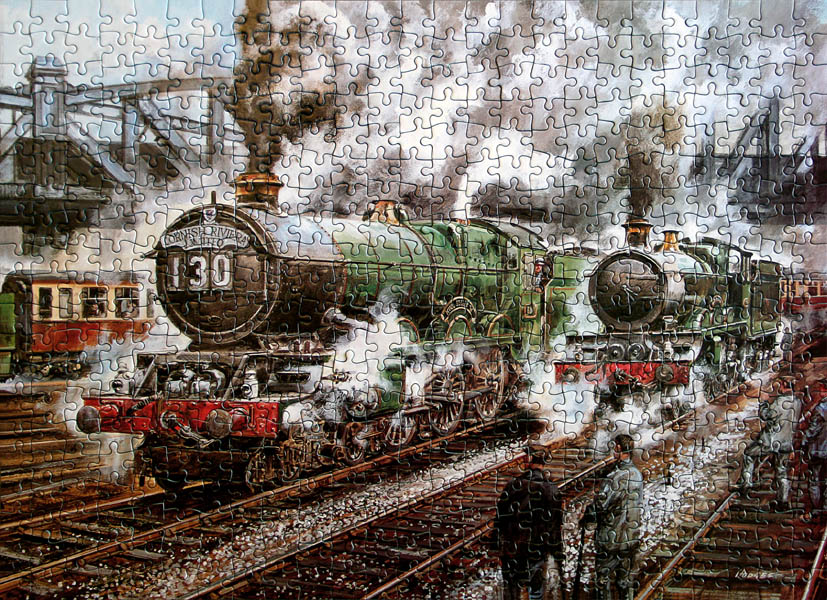
My passion for collecting jigsaw puzzles depicting steam trains began in the mid 1990's, roughly thirty years after my train spotting days ended. I came across a range of eight, 500-piece jigsaw puzzles in the Wilkinson's store in my home town, St Helens. They were in two series titled Nostalgia and Age of Steam, respectively,  and each series comprised four puzzles. They were made by a company called JR Puzzles and I felt compelled to collect them all, rediscovering my youth at the same time. The artist for all eight jigsaws was Edgar Hodges, his excellent illustrative paintings being ideal for reproduction as jigsaws. He was well known for signing his paintings with his surname only. Within a short time I had completed all eight puzzles plus a couple of others sold by the same store. I became obsessed with adding more and the collection started to expand.


In today's post (20th February 2011) I am including pictures of two of those original puzzles, both from the Nostalgia series. The first is Cornish Riviera Limited showing a giant 'King' class 4-6-0 locomotive, No.6019 King Henry V, at the head of this famous Paddington - Penzance express of the Great Western Railway. Another smaller 4-6-0 locomotive is travelling light engine on an adjacent line - possibly a 'Manor' class example. As usual, in Edgar Hodges' railway artwork, track maintenance men add human interest to the picture.


The second shot depicts British Railways 'Standard' class 4-6-2 locomotive, No.70004 William Shakespeare, heading the famous Southern Railway, 'Golden Arrow' service from London's Victoria Station to Dover. Track maintenance men are, once again, a feature. The 'Golden Arrow', all first class Pullman car service, began in 1929 (ordinary first and third class coaches were added in the early 1930's) but was terminated at the outbreak of World War II in 1939. It recommenced in 1946. Passengers were treated to a first class English Channel crossing from Dover to Calais on a specially refurbished ferry, Canterbury, owned by the  Southern Railway. At Calais passengers boarded an equally prestigious French train, the 'Fleche d'Or', for the journey to Paris. This French luxury Pullman service had started in 1926. 'Lord Nelson' and 'King Arthur' class locomotives were used on the 'Golden Arrow' initially, followed by Bullied 'Pacifics'; 'Britannia' class locomotives were also used until the steam-hauled service ended in 1961, when an electrified service took over.

Sunday, 13 February 2011

Steam and Alternative Transport

A steam train pictured with another mode of transport is a popular pairing with both artists and jigsaw manufacturers. The inclusion of any of the following - canal boats, veteran and vintage road vehicles, boats, bicycles/motorbikes or aeroplanes (occasionally) - within a steam train jigsaw picture - adds more pictorial interest. This post, 13th February 2011, includes two favourite examples from my collection.

Great Malvern, one of Gibsons' 636-piece panorama series, is reproduced from a fine painting by Eric Bottomley. An express headed by a Great Western Railway (GWR) 'Saint' class 4-6-0 of George Jackson Churchward waits in the station as a small branch line train approaches in the opposite direction. Two wonderful Morgan cars, a 1934 three-wheeled super sports beetleback, and a 1950 Plus-4 drophead coupe are parked in the adjoining station yard. The puzzle depicts two older examples of popular modes of transport gelled together into a wonderful image epitomising travel in early British Railways' days.

Another favourite of mine in this category is First of the Day, part of the Gibsons' Heritage series of both 500 and 1000 piece puzzles. This one is of 1000 pieces.  What a superb jigsaw from a Barry Freeman original canvas - a story book picture which is open to interpretation. A GWR 'Star' class 4-6-0 of George Jackson Churchward,  No.2902 Lady of the Lake, hauls a passenger express on a line adjacent to a canal where two, coal-bearing narrow boats are travelling in the opposite direction. A lone angler sits on the bank unhooking a fish. Has he just caught 'the first of the day', or is the train the 'first of the day' or are the boats the 'first of the day'.  My money is on the angler and his fish, but all three may qualify. They also appear to have been painted close to the first light of the day. The interpretation is open to the viewer.
At least two previous posts include puzzles which also show this classic pairing.

Monday, 7 February 2011

The Forth Bridge

A magnificent railway bridge is the focus of today's post (7th February 2011). I have chosen two different views of the bridge, as depicted on jigsaws in my collection.

One of the most famous bridges in the UK, the Forth Bridge, spanning the Firth of Forth in Scotland, is superbly captured in the 400-piece jigsaw by Good Companion. Titled simply, Forth Bridge,  the puzzle reproduces a T. E. North original painting illustrating the world's first, major steel bridge. Designed by Sir John Fowler and (Sir) Benjamin Baker, the huge structure is around 1.5 miles long and over 100 metres high; construction began in 1886. Local researchers estimate that 98 men were lost during its construction, much higher than the figure (57) reported on completion of the bridge. The official opening was performed by HRH The Prince of Wales, later King Edward VII, on 4th March 1890. The puzzle is shown in pic number one. A BR (ex LNER) express headed by a 4-6-2 'A2' class lcomotive, No.60525 A. H. Peppercorn,  is pictured traversing the bridge with a variety of boats and ships included on the river beneath.

The 'listed' bridge is also featured in pic number two.  A Gresley 'A4' class 4-6-2, No.60004 William Whitelaw, (Great Snipe prior to 1941) in BR blue livery, is shown crossing the bridge heading BR blue and grey coaches. The puzzle, from manufacturer Victory, is of 125 pieces but it was available in other sizes. The artist's name is not shown on the jigsaw - perhaps it is a 'cropped' version of the original canvas.

Tuesday, 1 February 2011

BR Blue Livery

The British Railways (BR) period of 1948-1968 heralded a set of new, standard liveries for steam locomotives including Caledonian Blue, lined with black and white, for the larger express passenger examples. The livery was short-lived, on quality/cost grounds, and had been replaced with Brunswick Green on many locomotives by 1952.  Nevertheless, the blue livery was attractive, accepted by many enthusiasts and popular with railway artists. Two examples of locomotives in BR express blue livery are shown in today's post, (1st February 2011) pictured on jigsaw puzzles from Valentines and Good Companion.


Picture number one shows a wooden puzzle of 80 pieces from Scottish manufacturer, Valentines. The picture is somewhat of an enigma, however, as a Gresley class 'A1' appears to be portrayed, in blue livery, with a Gresley class 'A4' number on the smokebox door. The BR number 60014 (LNER 2509) was attributed to 'A4' class locomotive Silver Link and not to an 'A1' (unless anyone can tell me otherwise). The picture shows the locomotive with a rake of BR carmine and cream coaches in a rural location. The artist was T.E. North.


A Good Companion jigsaw of 400 pieces is pictured next and is far easier to 'read' than the previous puzzle. The Fowler 'Royal Scot' class 4-6-0, No. 46132 The King's Regiment - Liverpool, is shown heading BR coaching stock. The train is exiting a tunnel in a rural setting, as favoured by some artists. The original artwork was by T. E. North.

Saturday, 29 January 2011

100 A1 Lloyds

This post (29th January 2011) is dedicated to a special locomotive of the Great Western Railway (GWR). The 'Castle' class 4-6-0 locomotive No.100 A1 Lloyds was rebuilt from a G. J. Churchward 'Star' class locomotive, No.4009 Shooting Star in 1925, during the tenure of Charles Collett as the GWR's Chief Mechanical Engineer. She retained the number and name until 1936 when, at a naming ceremony at Paddington, she became 100 A1 Lloyds. She was known as an oil burner in the late 1940's before being withdrawn from service in 1950. 

The Falcon 300-piece series Steamtrains  included a set of four jigsaws reproducing the paintings of George Heiron. One of them was Castle Class - GWR showing No.100 A1 Lloyds leaving Bristol Temple Meads Station with a Paddington bound express. This jigsaw is shown in the accompanying picture. The other three jigsaws in this particular set are County Class - GWR, Clan Class LMS, and Claughton Class - LMS. 
If you wish to know more about this oddly numbered and named 'Castle' just Google 'locomotive 100 A1 Lloyds' and many references will appear.

Wednesday, 26 January 2011

Two from Ravensburger

When I recently counted the number of jigsaw puzzles in my thematic, UK steam railway collection, (nearly four hundred) I was rather surprised to see seventeen Ravensburger examples, more than I thought. I have chosen two for this post (26th January 2011) with original artwork by Trevor Mitchell and Kevin Walsh.

The Rivals is a 500-piece puzzle featuring a Great Eastern Railway (GER) class T26, (LNER class E4) 2-4-0 tender  locomotive, No.7490. The loco is heading a short passenger train beside a country road on which an old vintage bus (1920's?) is 'speeding' along. The battle for supremacy between road and rail is a popular subject among jigsaw manufacturers and Trevor Mitchell's artwork doesn't disappoint. The milk churns add to the country atmosphere. The locomotive, one of a class of 100 designed by James Holden from 1891, is preserved at Bressingham Museum. Can anyone send me information about the bus? (Email address at the top of the blog).


The 1000-piece jigsaw, Watching the Trains, is a wonderful study of two children, a small boy and an older girl, admiring 'The Flying Scotsman' train as it powers by. A small dog is held on a lead by the boy to add to the ambience, and the children wave to the engine driver and passengers. Kevin Walsh must have painted a scene from British Railways' days, (1950's) when the complete name of the express, including the definite article, was used on the headboard. The logo on the tender and the number 4472, both of LNER origin (pre BR days), are puzzling, however.

Saturday, 22 January 2011

Age of Steam

Production of The Age of Steam series of steam railway jigsaw puzzles, by Arrow Games, began in the same year that the company was formed - 1965. All the series of four, 500-piece puzzles were made between 1965 and 1980. The jigsaws were made in Ireland even after Arrow became part of the Milton Bradley Group in 1972.  A series of 300-piece puzzles was also produced in 1985. This post (22nd January 2011) comprises two pics showing examples from the the first and third series, and a third showing a printed description of series one.
The first pic shows No.6105 Cameron Highlander of the LMS, climbing Camden Bank, after exiting Euston Station with the 'Royal Scot' express. Details of each of the four jigsaws in this first series were included with every  puzzle, as an A5 printed sheet. It is important to preserve this sheet with each puzzle; pic number two shows the printed sheet. The provision of such details meant that each jisaw had no box title. The original artwork for this jigsaw was by George Heiron, who in my view, was one of the best artists at replicating exhaust.
The third pic in the post shows a jigsaw from the 1980 series titled LMS Compound. The artist is not named. The class 4P 4-4-0 locomotive, No. 41125, heading a rake of BR carmine & cream coaches is depicted passing through a distinctively rural scene. One hundred and ninety five of the class were built by the LMS between 1924 and 1932. The Midland Railway had previously built forty five which were integrated into the LMS batch.
I am still receiving comments (mostly positive) about the blog, but if you wish me to reply please email me by clicking on the email address at the top of the blog.

Tuesday, 11 January 2011

Collages

Jigsaw puzzles in the form of composites/collages/montages are increasingly popular with jigsaw manufacturers today, with King and Gibsons to the fore. Today's post (11th January 2011) comprises two such jigsaw puzzles but from two other manufacturers - Ravensburger and Ryco Crafts (for the National Railway Museum, York). 

The first pic shows a rectangular composite of four equal parts from Ravensburger. Pictured are  the LMS 4-6-2,  No.6201 Princess Elizabeth designed by William Stanier; the LNER 4-6-2, No.4498 Sir Nigel Gresley designed by Nigel Gresley; the GWR 4-4-0, No.3440 City of Truro designed by George Jackson Churchward; the LNER 4-6-2 No.4472 Flying Scotsman designed by Nigel Gresley. The jigsaw, of 1000 pieces, is titled The Magic of Steam.


The jigsaw from Ryco Crafts for the NRM is shown in pic number two. The jigsaw of 520 pieces depicts four locomotives from the national collection; the design is similar to the previous puzzle. Pictured
 are the following - Gresley's 4-6-2s, No.4472 Flying Scotsman and No.4468 Mallard; George Stephenson's Rocket; Samuel Waite Johnson's 4-4-0 (Midland Compound) No.1000. The jigsaw is titled Festival of Steam.

Tuesday, 4 January 2011

Wartime Steam

The railways played a crucial part in transportation throughout the Second World War. This post, our first for 2011, comprises two jigsaw puzzles each one showing a different aspect of wartime railway traffic.


The first picture shows a Waddingtons' jigsaw puzzle of 500 pieces titled Christmas Leave. Featured is a  typical wartime station scene by artist Trevor R. Owens.  A southbound train is slowly pulling into Lancaster Station headed by LMS 'Black 5' locomotive No. 4905. Waiting on a snow-covered platform are men and women of the Armed Forces, ready to board and travel home for Christmas. The sunset and low level of natural lighting complement the artificial station lights to impart a warm, evocative ambience to the picture.


The second photograph features a 1000-piece puzzle from Gibsons titled The Evacuees. On August 31st 1939, the government issued the order "Evacuate Forthwith" and the operation to evacuate nearly 2 million of Britain's school children began. 'Operation Pied Piper' became the biggest and most concentrated mass movement of citizens in our history. Within a few days 1.9 million school children had been transported from major towns and cities, in danger from German bombing raids, to places of greater safety in the countryside. Many other children of wealthy families were evacuated privately. The jigsaw reproduces an original painting of Stalbridge Station in Dorset, by Kevin Walsh.  In Kevin's superb picture children and their chaperones (including teachers) have disembarked from a train. At the head is a  'Lord Nelson' class 4-6-0 locomotive designed by Richard Maunsell. Children are gathered in the station approach yard, some boarding a bus (a Guy?), whilst others are enjoying stretching their legs or taking refreshments from assembled members of the WVS (Women's Voluntary Service).