Blogmaster

If you wish to communicate with me about steam train jigsaws and/or related railway art, or to respond to requests for answers to my queries, please email David, at : platt.precology@gmail.com

Monday, 28 March 2011

Record Breakers

Coronation and Mallard are two British steam locomotives synonymous with power and speed. The first, a creation of Sir William Stanier of the London Midland Scottish Railway, achieved 114 mph in 1937, a British record. The 'A4' class locomotive designed by Sir Nigel Gresley of the London and North Eastern Railway, achieved 125mph in 1938, a world record for steam locomotion. This figure was acknowledged by Gresley himself although others published an unsubstantiated 126 mph. Today's post, 28th March 2011, comprises two pics showing jigsaws from Falcon's 300-piece Steamtrains series of four puzzles. They all reproduce  the superb artwork of Rob Johnson. A third pic features an information sheet.

The first pic features the jigsaw titled  Princess Coronation Class - LMS.  The 'Coronation Scot', Euston - Glasgow express, was named to coincide with the year of the Coronation of King George VI. It was headed, initially, by Stanier 'Coronation' class 4-6-2, No.6220 Coronation, and a record speed of 114mph was achieved on the inaugural run on 29th June 1937. The location was just south of Crewe on the West Coast Main Line. The 'Coronation' class of locomotives was specially designed for the service. Until 1939 the locomotives and coaches were blue with silver bands but afterwards changed to LMS red with gold bands. The train did not appear after World War II, consigned to history.

Pic number 2 shows the jigsaw titled The Mallard - LNER. Mallard's world record run was achieved on 3rd July 1938 on Stoke Bank, just south of Grantham, on the East Coast Main Line. In the jigsaw the famous 'Streak', No.4468, is hurtling past a local policeman who has stopped cycling to enjoy the experience. It is a picture of contrasts, but also one that epitomises the appeal of steam locomotion.


The third pic shows the information sheet which accompanied each jigsaw in the 300-piece Steamtrains series.

If you wish to view all the photographs published on this blog, either individually or as a slide show, follow the instructions to the right hand side of the blog under the heading 'Picasa Slide Show'. Each photograph is captioned with title, number of pieces and manufacturer.

Monday, 21 March 2011

Puffing Billy, Jupiter and North Star

I am returning to the early days of steam locomotion for today's post, 21st March 2011. Two jigsaws in my collection are a perfect fit for this subject.


My first pic shows a 200-piece jigsaw marketed by William Ellis & Co Ltd under the 'Welcom' brand. Titled Discovery of Steam Locomotion the puzzle features the oldest surviving steam locomotive in the world, Puffing Billy. The engine is on display at the Science Museum, London. Built in 1813 by the famous engineer William Hedley, the steam engine was used to haul coal trucks from a mine at Wylam to the docks at Lemington-on-Tyne in Northumberland. It is known to be the first, commercial adhesion, steam locomotive to have operated on smooth rails. The brightly coloured, illustrative style artwork for the puzzle is not signed, unfortunately, but shows the locomotive in a rural setting, possibly en route to the docks.


My second pic shows a superb hand cut, wooden jigsaw by the renowned specialist Sara White. Titled Travelling on the Liverpool & Manchester Railway - 1831, the 430-piece puzzle dates from 1999. The original work was by Isaac Shaw and aquatinted by S. G. Hughes but Sara's jigsaw is from a Raphael Tuck commercial print that replicated the coloured aquatint. The jigsaw features two trains - a first class train with an additional mail coach attached to the rear, and a second and third class example, with open carriages. The first class train is headed by the locomotive Jupiter, built by Robert Stephenson's engineering company in 1831. Jupiter was a locomotive of the 'Planet' class of 2-2-0 locomotives and is incorrectly portrayed with four equal wheels. The second train headed by the locomotive North Star, of 0-2-2 configuration, was built by the same engineers a year earlier, complete with water barrel tender. 
 
Thankfully, manual techniques for manufacturing wooden jigsaw puzzles are still carried out by a number of traditionalists who will hand cut you an elaborate puzzle of excellent quality. However, when one considers that a hand cut jigsaw of 1000 pieces, for example, involving high degrees of skill, patience and creativity will normally take over a normal working day to produce, it doesn't require mathematical genius to work out the expense involved.

Monday, 14 March 2011

Major London Stations

Today's post, 14th March 2011, is dedicated entirely to two mainline terminus stations in London. Jigsaws depicting stations as a backdrop to a steam locomotive or train are common, but those showing the station as the main focal point, with trains relegated to the background, are exactly the opposite. The two pictures of jigsaw puzzles I have chosen today, show stations and passengers that more or less fill the picture frame.

The first pic features the Gibsons' 1000-piece puzzle titled Going North; Coming South. 'Going North' and 'Coming South' are a pair of paintings by George Earl, originally commissioned by Sir Andrew Barclay Walker, owner of a Liverpool brewery. Victorians had a rather curious affinity for railway stations. The pair of paintings, completed in 1895 and rescued from a Liverpool public house in 1990, show many cameos of Victorian railway station life towards the end of the 19th Century. 'Going North' depicts well-dressed passengers, including Earl himself and members of the Walker family, waiting at Kings Cross Station, Scotland bound. 'The Glorious Twelfth' immediately springs to mind. In 'Coming South' the opposite journey is depicted, passengers waiting at Perth Station for a Kings Cross train, returning to London with their 'prizes'. In both paintings thirty-four sporting dogs of eight different breeds are portrayed, a favourite subject of Earl. The Gibsons' jigsaw cleverly combines both paintings to great effect.

My second shot shows St Pancras Station in the form of a 1000-piece jigsaw made by Ravensburger for the National Railway Museum, York. The title is Going North? St Pancras and it is reproduced from a 1910 Midland Railway Poster by Fred Taylor. This majestic station was completed for the Midland Railway in 1868. It was close to the Great Northern Railway's Kings Cross Station and was built because of massive delays in approaching Euston Station, previously used for London-bound passengers. A new line from Bedford was built for the opening of St Pancras. Because Taylor's artwork was commissioned for a poster, the fine detail shown in Earl's paintings was not required; also, because the scene is of a panoramic nature, it has slightly less impact.

Wednesday, 9 March 2011

Old Workhorses

I know that 'Old Workhorses' is a worn out cliche but there is nothing better to describe the two jigsaw puzzles I have chosen for today's post, 9th March 2011. Farming, especially ploughing or the harvesting of crops,are popular subjects for foregrounds in pictures of steam railway scenes. Many artists have used this pairing of steam train and farming to add pictorial impact to their work and jigsaw manufacturers have not been slow to reproduce it.

The first pic shows a 1000-piece jigsaw from Waddingtons titled, appropriately, Old Workhorses. The puzzle compares older means of both travel and farming and is reproduced from a Malcolm Root original painting. This jigsaw is not as easy to assemble as others described in previous posts. Many pieces replicate colour and texture, particularly those that make up the ploughed field, making it a time consuming exercise to complete. Sold by Woolworths before the company's demise in December 2008, the puzzle features a T.W.Worsdell Class 'F4', 2-4-2T tank, No. 67211, heading two small suburban coaches along a raised embankment. The scene is set in early British Railways days. In the foreground a farmer ploughs his field using four magnificent shire horses to pull the plough.

Another fine example in this category, reproduced from a Trevor Mitchell canvas, is the JR Puzzles 500-piece example titled Homeward Bound, part of the Days Gone By series. A Gresley 'C9' class 4-4-2 locomotive, No.2171 of the London and North Eastern Railway, (LNER) is shown heading a rake of Gresley teak coaches. On an adjacent road an old Burrell steam traction engine with two men on board and two trailers in tow, plods along, heading away from a day on the farm.

The summer scenes above, produced by both artists, radiate tranquillity, all that is best in the UK countryside.


NOTE: JR Puzzles are now owned and distributed by James Hamilton Grovely Puzzles Ltd.,  -  for details, the email address is info@jhgpuzzles.co.uk and the website is jhgpuzzles.co.uk

Friday, 4 March 2011

Freight/Goods Trains


They were called goods trains in my day but most people call them freight trains today. Whatever you call them, today's post, 4th March 2011, features photographs of jigsaw puzzles showing such trains. For some reason that I don't understand, freight trains are not widely covered by jigsaw manufacturers, passenger examples outnumbering them by a huge margin. I have chosen two pictures from my collection to illustrate the post title.

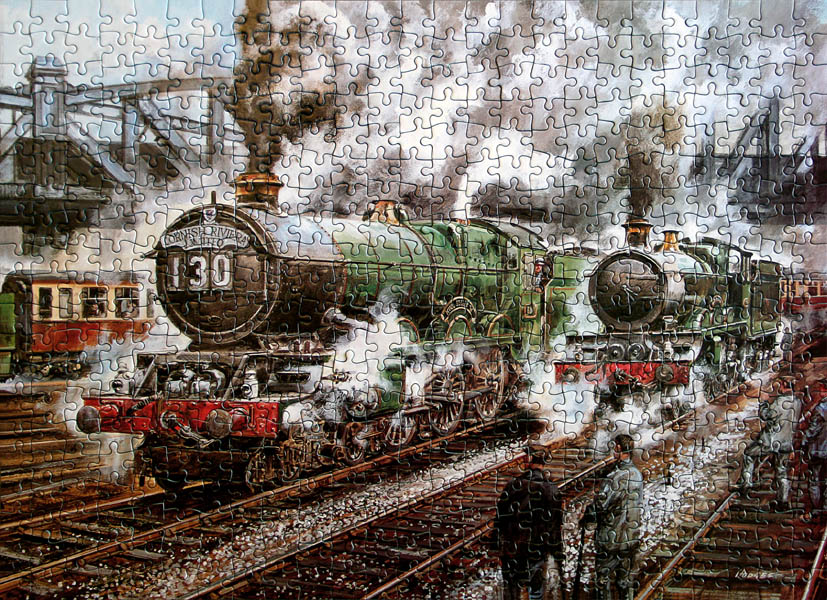
Pic number one shows a 500-piece puzzle from Moat House Products. In the pic one of Charles Collett's 4-6-0 workhorses, No.5904 Kelham Hall, coupled to a large eight-wheeled tender, is heading freight vans under a bridge on Rattery Bank. The 'Hall' class of mixed traffic locomotives came into service on the Great Western Railway in 1924 and over 250, including modified versions, were built.  David M. West produced the original artwork for the jigsaw, which is one of a series of six.


The second pic shows a 500-piece wooden puzzle from Wentworth. Barry Freeman's original painting of The Haymarket Wanderer has reproduced superbly as a jigsaw. The puzzle is available in several different sizes from Wentworth and depicts a Arthur H. Peppercorn 'A1' class 'Pacific', No.60160 North British, in BR blue livery, heading a long goods train of mixed wagons and vans. The setting is Welwyn North Station, a rather odd place to see a locomotive from Haymarket shed in Edinburgh; hence the title of the painting.

Friday, 25 February 2011

Two more from Wentworth

Since the Wentworth company began manufacturing their famous wooden puzzles in 1994, steam train examples have been prominent. Over seventy titles have been produced, although many are no longer available. Of the two I have chosen to include in today's post, 25th February 2011, only the first is currently in production. More Wentworth puzzles have been included in previous posts - just type Wentworth in the search bar above.
 My first pic shows the 250-piece puzzle Clouds and Crosswinds which is reproduced from a Malcolm Root original painting. One of William Stanier's magnificent 'Princess Coronation' class 4-6-2s, No.46238 City of Carlisle, is depicted hard at work on the northern West Coast Main Line (WCML) approaching the summit at Shap. Set in the late 1950's/early 1960's, Malcolm's picture highlights the bleak terrain, threatening skies and strong crosswinds.

The second pic features a famous express of the London Midland Scottish Railway, the 'Royal Scot'. One of Henry Fowler's 4-6-0 creations, later modified by William Stanier, is shown heading the famous express on the northern WCML, close to the location used by Malcolm Root for Clouds and Crosswinds. The 250-piece jigsaw replicates a Gerald Broom original painting, although it is not one of Wentworth's best reproductions. The title is LMS Royal Scot, Tebay Troughs and the pioneer locomotive of the class, No.6100 Royal Scot, is shown picking up water from the famous troughs. Large amounts of spray, characteristic of this type of operation, are used to advantage in the painting. The picture also features an early farming scene, including a horse and lots of manual  labour, typical of early LMS days.

Wentworth jigsaw puzzles are available in many different sizes.

Sunday, 20 February 2011

The Beginning, with JR

My passion for collecting jigsaw puzzles depicting steam trains began in the mid 1990's, roughly thirty years after my train spotting days ended. I came across a range of eight, 500-piece jigsaw puzzles in the Wilkinson's store in my home town, St Helens. They were in two series titled Nostalgia and Age of Steam, respectively,  and each series comprised four puzzles. They were made by a company called JR Puzzles and I felt compelled to collect them all, rediscovering my youth at the same time. The artist for all eight jigsaws was Edgar Hodges, his excellent illustrative paintings being ideal for reproduction as jigsaws. He was well known for signing his paintings with his surname only. Within a short time I had completed all eight puzzles plus a couple of others sold by the same store. I became obsessed with adding more and the collection started to expand.


In today's post (20th February 2011) I am including pictures of two of those original puzzles, both from the Nostalgia series. The first is Cornish Riviera Limited showing a giant 'King' class 4-6-0 locomotive, No.6019 King Henry V, at the head of this famous Paddington - Penzance express of the Great Western Railway. Another smaller 4-6-0 locomotive is travelling light engine on an adjacent line - possibly a 'Manor' class example. As usual, in Edgar Hodges' railway artwork, track maintenance men add human interest to the picture.


The second shot depicts British Railways 'Standard' class 4-6-2 locomotive, No.70004 William Shakespeare, heading the famous Southern Railway, 'Golden Arrow' service from London's Victoria Station to Dover. Track maintenance men are, once again, a feature. The 'Golden Arrow', all first class Pullman car service, began in 1929 (ordinary first and third class coaches were added in the early 1930's) but was terminated at the outbreak of World War II in 1939. It recommenced in 1946. Passengers were treated to a first class English Channel crossing from Dover to Calais on a specially refurbished ferry, Canterbury, owned by the  Southern Railway. At Calais passengers boarded an equally prestigious French train, the 'Fleche d'Or', for the journey to Paris. This French luxury Pullman service had started in 1926. 'Lord Nelson' and 'King Arthur' class locomotives were used on the 'Golden Arrow' initially, followed by Bullied 'Pacifics'; 'Britannia' class locomotives were also used until the steam-hauled service ended in 1961, when an electrified service took over.

Sunday, 13 February 2011

Steam and Alternative Transport

A steam train pictured with another mode of transport is a popular pairing with both artists and jigsaw manufacturers. The inclusion of any of the following - canal boats, veteran and vintage road vehicles, boats, bicycles/motorbikes or aeroplanes (occasionally) - within a steam train jigsaw picture - adds more pictorial interest. This post, 13th February 2011, includes two favourite examples from my collection.

Great Malvern, one of Gibsons' 636-piece panorama series, is reproduced from a fine painting by Eric Bottomley. An express headed by a Great Western Railway (GWR) 'Saint' class 4-6-0 of George Jackson Churchward waits in the station as a small branch line train approaches in the opposite direction. Two wonderful Morgan cars, a 1934 three-wheeled super sports beetleback, and a 1950 Plus-4 drophead coupe are parked in the adjoining station yard. The puzzle depicts two older examples of popular modes of transport gelled together into a wonderful image epitomising travel in early British Railways' days.

Another favourite of mine in this category is First of the Day, part of the Gibsons' Heritage series of both 500 and 1000 piece puzzles. This one is of 1000 pieces.  What a superb jigsaw from a Barry Freeman original canvas - a story book picture which is open to interpretation. A GWR 'Star' class 4-6-0 of George Jackson Churchward,  No.2902 Lady of the Lake, hauls a passenger express on a line adjacent to a canal where two, coal-bearing narrow boats are travelling in the opposite direction. A lone angler sits on the bank unhooking a fish. Has he just caught 'the first of the day', or is the train the 'first of the day' or are the boats the 'first of the day'.  My money is on the angler and his fish, but all three may qualify. They also appear to have been painted close to the first light of the day. The interpretation is open to the viewer.
At least two previous posts include puzzles which also show this classic pairing.

Monday, 7 February 2011

The Forth Bridge

A magnificent railway bridge is the focus of today's post (7th February 2011). I have chosen two different views of the bridge, as depicted on jigsaws in my collection.

One of the most famous bridges in the UK, the Forth Bridge, spanning the Firth of Forth in Scotland, is superbly captured in the 400-piece jigsaw by Good Companion. Titled simply, Forth Bridge,  the puzzle reproduces a T. E. North original painting illustrating the world's first, major steel bridge. Designed by Sir John Fowler and (Sir) Benjamin Baker, the huge structure is around 1.5 miles long and over 100 metres high; construction began in 1886. Local researchers estimate that 98 men were lost during its construction, much higher than the figure (57) reported on completion of the bridge. The official opening was performed by HRH The Prince of Wales, later King Edward VII, on 4th March 1890. The puzzle is shown in pic number one. A BR (ex LNER) express headed by a 4-6-2 'A2' class lcomotive, No.60525 A. H. Peppercorn,  is pictured traversing the bridge with a variety of boats and ships included on the river beneath.

The 'listed' bridge is also featured in pic number two.  A Gresley 'A4' class 4-6-2, No.60004 William Whitelaw, (Great Snipe prior to 1941) in BR blue livery, is shown crossing the bridge heading BR blue and grey coaches. The puzzle, from manufacturer Victory, is of 125 pieces but it was available in other sizes. The artist's name is not shown on the jigsaw - perhaps it is a 'cropped' version of the original canvas.

Tuesday, 1 February 2011

BR Blue Livery

The British Railways (BR) period of 1948-1968 heralded a set of new, standard liveries for steam locomotives including Caledonian Blue, lined with black and white, for the larger express passenger examples. The livery was short-lived, on quality/cost grounds, and had been replaced with Brunswick Green on many locomotives by 1952.  Nevertheless, the blue livery was attractive, accepted by many enthusiasts and popular with railway artists. Two examples of locomotives in BR express blue livery are shown in today's post, (1st February 2011) pictured on jigsaw puzzles from Valentines and Good Companion.


Picture number one shows a wooden puzzle of 80 pieces from Scottish manufacturer, Valentines. The picture is somewhat of an enigma, however, as a Gresley class 'A1' appears to be portrayed, in blue livery, with a Gresley class 'A4' number on the smokebox door. The BR number 60014 (LNER 2509) was attributed to 'A4' class locomotive Silver Link and not to an 'A1' (unless anyone can tell me otherwise). The picture shows the locomotive with a rake of BR carmine and cream coaches in a rural location. The artist was T.E. North.


A Good Companion jigsaw of 400 pieces is pictured next and is far easier to 'read' than the previous puzzle. The Fowler 'Royal Scot' class 4-6-0, No. 46132 The King's Regiment - Liverpool, is shown heading BR coaching stock. The train is exiting a tunnel in a rural setting, as favoured by some artists. The original artwork was by T. E. North.