Blogmaster

If you wish to communicate with me about steam train jigsaws and/or related railway art, or to respond to requests for answers to my queries, please email David, at : platt.precology@gmail.com

Saturday, 20 October 2012

National Railway Museum Jigsaws

Ryco Crafts of Ripon produced jigsaw puzzles for the National Railway Museum (NRM) in 2004 and two of them are featured in today's post, 20th October 2012.
 
 
Both puzzles comprise 500 pieces. The first, titled Steamfest, features a reproduced photograph of  two locomotives at this gala event. On the left is David Shepherd's BR class '9F' 2-10-0,  92203 which he named Black Prince. This name was not carried by any locomotive for BR.  The famous wildlife artist purchased two steam locomotives from British Railways (BR) in 1967 - No.92203 and BR 'Standard' class '4MT' 4-6-0 No.75029 which he subsequently named The Green Knight. Following a diligent search for land in south west England on which he could build a railway, David found a derelict area at Cranmore in 1971. Together with enthusiastic friends, David purchased the site and the East Somerset Railway was opened two years later. On the right hand side in the jigsaw picture is SR 'King Arthur' class 4-6-0, No.30777 Sir Lamiel, part of the National Collection.


The second jigsaw photograph depicts (Sir) Nigel Gresley's class 'A1' (later 'A10' and 'A3') 4-6-2, No.4472 Flying Scotsman, also the title of the jigsaw.The locomotive has been immortalised in many forms, not least in jigsaw puzzles. Most jigsaw manufacturers / retailers pictured Flying Scotsman  in pre-1960 form, without smoke deflectors - Falcon, Ravensburger, Arrow, Victory, Hope, W. H. Smith and Tower Press for example.The NRM issued the puzzle replicating a photograph of the locomotive with German-style smoke deflectors (affectionately known as 'blinkers') attached. The icon of UK railways became part of the National Collection in 2004, purchased for the nation with private, public and Heritage Lottery funding.

A third Ryco Crafts / NRM jigsaw puzzle published at the same time is described in the post of 11th January 2011.

Tuesday, 18 September 2012

Two from House of Puzzles

Today's post, 18th September, features the artwork of Keith Stapleton reproduced by jigsaw manufacturer House of Puzzles of Invergordon, Scotland.
  
The first picture shows a puzzle from the Rowan Collection, comprising 250 large, unusually shaped pieces and titled Seaside Special. The location is similar to that described in my post of 22nd July 2012 - Dawlish.  Ex GWR 4-6-0 locomotive No.4003 Lode Star was designed by George Jackson Churchward  and built in 1907. In the jigsaw picture the locomotive is shown heading familiar chocolate and cream passenger coaches along the line adjacent to the sea wall. In addition to many holiday revellers, Keith’s all-inclusive artwork features sand castles, sea gulls, a beach ball, deck chairs, an ice cream cabin, a ‘Punch and Judy’ show, a flying kite and the obligatory dog. The BR logo on the tender rather oddly dates the pic between 1956 and 1968 although the loco was withdrawn from service in 1951. Lode Star is part of the National Collection at the National Railway Museum in York.
The second picture features a 500-piece puzzle from the Ruxley Collection titled Country Crossing. This puzzle also comprises unusually shaped pieces. The jigsaw conveys the serene ambience of country village life from the 1920's/1930's. North Eastern Railway (NER) class D22, 4-4-0 locomotive No. 1537, of  T. W. Worsdell, is shown heading suburban passenger stock on a single line beside a dirt track. The scene includes a small public house, two customers seated outside, a man standing beside a bicycle and another, possibly a local farmer, approaching on a horse. A canal viaduct complete with canal boat is included in the backgound. Several geese, bees and pigeons are also included in a very busy picture. The locomotive was built in 1890 and withdrawn from LNER service in 1935. 

Friday, 31 August 2012

Two More Gresley Locomotives

In today's post, 31st August 2012, I am featuring two locomotives from classes designed by the famous GNR/LNER mechanical engineer (Sir) Nigel Gresley. 
The first pic features a wooden jigsaw of 200 pieces from Ponda which probably originated from Ian Allan. In Robert Barnard Way's artwork, Gresley's  'V2' class 2-6-0 locomotive, No.60877, (built in 1940) is shown in BR black livery  hauling a long rake of BR carmine & cream ('blood and custard') coaches over the King Edward VII bridge at Newcastle. The 'cycling lion' BR motif indicates a time period of 1948-1956 for Way's painting. The full title of the puzzle is British Railways: Southbound Express hauled by Class V2 60877, on the King Edward VII bridge, Newcastle-on-Tyne. North Eastern Region. The curved shape of the train suits the portrait style (vertical) perfectly.


The second shot is of a 500-piece puzzle from Falcon titled Flying Scotsman. The artwork is by George Heiron. Featured is Gresley's 'A1' class 4-6-2 locomotive No.2750 Papyrus. The locomotive  was built in 1929 and was upgraded to 'A3' status following a rebuild in BR days, 1963. The LNER express, Kings Cross - Edinburgh, in the picture comprises Gresley's famous teak coaches. The definite article was added to the express headboard by BR in the 1950's.

Sunday, 19 August 2012

Steam with Other Modes of Transport

Artwork, showing steam trains with alternative modes of transport, has been used by jigsaw manufacturers for many years. Cars, aeroplanes, buses, canalboats and ships have been included with steam trains for different reasons, some purely pictorial, others for comparison purposes. Races between steam trains and road vehicles for instance have always been popular, and canal boats have often been used in conjunction with a busy main railway line to introduce tranquility. Today's post, 19th August 2012, includes three pictures of jigsaw puzzles showing alternative modes of transport compared and contrasted with steam locomotion.


The first pic features a jigsaw of 500 pieces from Falcon/Jumbo depicting two Spitfire aeroplanes, a steam train and a small vintage car. I am no expert on the latter but perhaps the car in the picture is an Austin Seven which was manufactured until 1939. The planes are overflying the railway which can be interpreted - wartime or peacetime -  in different ways; the train is depicted at a small rural crossing. The driver of the parked, lineside car watches intently as railway workers and train passengers wave to the pilots. The jigsaw title is Planes, Trains and Automobiles although there is only one train and one car. The artwork is by Bill Perring. The locomotive is a class 'H' 0-4-4T tank engine, No. 1263 of the  Southern Railway, previously of the South East & Chatham Railway.


Seaside Traffic, a Victory wooden jigsaw of 300 pieces, from original artwork by T. E. North, is shown in pic number two. It is a fine example of a steam train as the focal point with other examples of transport sharing the picture space. A train headed by BR 'Standard' class '7' 4-6-2, No.70001 Lord Hurcomb, is shown at speed beside a busy road. A coach, a car and caravan and a small lorry are shown on the road while to the other side of the railway line is the sea. On the sea are two passenger ships and several, small recreational craft. The puzzle is available as 'used' in  a range of sizes, 75-400 pieces.


Continental holidays were well served by the Southern Railway. In the 636-piece panoramic puzzle from Gibsons (pic number three) a luxury boat train is pictured at the Ocean Liner Terminal at Southampton. The Cunarder - a Waterloo to Southampton Pullman service - is the name of both the train and the jigsaw puzzle. The artwork is by Malcolm Root and the locomotive in his picture is ‘Battle of Britain’ class 4-6-2, No.34081 92 Squadron, which is now preserved and owned by the Battle of Britain Locomotive Society. The ocean liner in the picture is Cunard Line’s Queen Mary; a stylish, chauffeur-driven car and a couple of 1950’s coaches are added for effect. A photograph of ‘The Cunarder’ train, similar to Malcolm’s artwork but including a ‘Lord Nelson’ class 4-6-0 and a different headboard, is shown in Dave Peel’s excellent book, ‘Locomotive Headboards - The Complete Story’.


Further examples of jigsaws  featuring steam trains and other forms of transport can be seen in the following posts  - 30th July 2010 (aeroplane); 3rd October 2010 (vintage cars); 13th February 2011 (vintage cars and canal boats); 9th March 2011 (Burrell steam traction engine); 28th March 2011 (bicycle); 25th June 2011 (ship). There are many more.

Sunday, 22 July 2012

The Attraction of Dawlish

In this post, 22nd July 2012, I am using three photographs of jigsaw puzzles each one replicating the same location - the sea wall at Dawlish.

The Great Western main line hosts one of the most pictorial stretches of railway in Britain. Hugging a spectacular coastline of red sandstone rock between Teignmouth and Dawlish, the line has acted like a magnet to every railway artist of distinction, the sea wall at Dawlish especially so. The line and adjacent footpath are situated in close proximity to the sea with all three hardly separated during spells of inclement weather.

The line, originally from Exeter to Teignmouth,  was opened in 1846 by the South Devon Railway Company. Later in the same year the line was extended to Newton Abbott. Isambard Kingdom Brunel engineered the line to his broad gauge and intended it to function as an atmospheric railway. The latter lasted for one year only and was abandoned in 1848 in favour of steam locomotion. The South Devon Railway became part of the Great Western Railway in 1876 and was converted to standard gauge in 1892. The following three jigsaw puzzle pictures all show the line and sea wall at Dawlish but they are by different artists.


The first picture shows a King jigsaw of 500 pieces from original artwork by Malcolm Root. Titled Following the Train, the jigsaw features a GWR ‘King’ class 4-6-0 No. 6000 King George V hauling chocolate and cream liveried passenger coaches in the popular location. The famous bell on the locomotive is clearly shown. A family party on holiday in Devon, complete with a baby in a large, 1950’s style pram, follows the train for a short distance. This locomotive is preserved. I have used this example in a previous post but feel justified in repeating its use in this specific context.


A slightly different viewpoint has been used by another famous artist, Don Breckon. Picture number two shows a 240-piece wooden puzzle titled On the Sea Wall although its origin is unknown to me. GWR 'King’ class 4-6-0 No.6000, King George V is again the featured locomotive in Don’s artwork. The people on the footpath are different but from the same era.


Mike Jeffries also used the sea wall for a painting replicated as a 1000-piece puzzle currently on sale at ‘The Works’ chain of stationers. Titled A Trip to the Seaside, the jigsaw features the 4-6-0 ‘Star’ class locomotive No.4003 Lode Star  but with different  pedestrians on the footpath. The locomotive was withdrawn from BR service in 1951 and is part of the National Collection based at the National Railway Museum in York. Mike  painted the same scene on another occasion but with GWR 'Hall' class 4-6-0 No.4920 Dumbleton Hall at the head of the train; this latter painting has not been used for a jigsaw puzzle however, to the best of my knowledge.


Monday, 2 July 2012

Heritage Railways


The name Whitman is synonymous with jigsaw puzzles featuring Heritage Railways, and steam railways in particular. Whitman covered many such railways during the 60's and 70's with their 400-piece 'Steam Railways' series. There were three 'Steam Railways' series, (7414, 7525 and 7714) each of four puzzles, all reproducing photographs of variable quality. Also collectible is the 'Great Little Trains of Wales' series (7695) of six, 400-piece puzzles. Today's post, 2nd July 2012, focuses on two more jigsaws featuring Heritage or Preserved Railways. Over one hundred establishments with preserved railway lines can be visited in the UK.


The first picture features the North Yorkshire Moors Railway based at Pickering. The line runs from Pickering to Grosmont and  hosts a station in the village of Goathland, the setting for ITV's popular programme, 'Heartbeat'. From Grosmont passengers may join a Network Rail line to Whitby. The NYMR also run services through to the seaside town. The jigsaw in the picture is a 250-piece, wooden example from Wentworth simply titled North Yorkshire Moors Railway. The locomotive in the picture is an ex Southern Railway'S15' class, No.825, originally designed by Robert Urie. The class of 4-6-0s were initially seen on the London & South West Railway from 1920; No.825 was built in 1927 and withdrawn from BR service in 1964. She was one of the second batch of 'S15's modified by Richard Maunsell. The location in the picture is Goathland station. Before the railway from Grosmont to Pickering was completed in 1975 the line had been opened in stages from its humble origin in 1968.


The second picture shows a scene from the Keighley & Worth Valley Railway based at Keighley in Yorkshire. A Preservation Society was formed in 1962 to save the line following closure by British Railways. The 4.5miles long line runs from Keighley to Oxenhope and was formally opend in 1967. Although much shorter that the NYMR it is just as scenic as it passes through 'Bronte' country at Hawarth. The picture features an 0-6-0ST saddle tank locomotive but the number is unclear. The jigsaw is a 400-piece example from Whitman titled Keighley & Worth Valley Railway.

Sunday, 17 June 2012

Two Stations

First of all may I thank the people who email me with support for my blog. For today, 17th June 2012, I am using two pics of jigsaws each featuring a main line station.


The first pic shows a 500-piece puzzle from Ravensburger titled Derby Station, 1950's, with artwork from Robert Nixon. The station architect was Francis Thompson and the first train, a Midland Counties service to Nottingham, left from a temporary platform on 4th June 1839. The station opened completely in  the following year. It soon became known as the 'Tri-Junct Station' as it served three separate railway companies - Midland Counties, Birmingham & Derby Junction and North Midland. The three railway companies amalgamated in 1844 to become the Midland Railway Company with Derby Station as the HQ. Major changes were made to the 1050ft long station frontage in 1856 and 1872. The locomotive in the picture is a London Midland & Scottish Railway (LMS) 'Jubilee' class 4-6-0 No.45589 Gwalior.


The second shot shows Carlisle Citadel Station with a  LMS  4-6-2, 'Princess Coronation' class locomotive No.6233, Duchess of Sutherland, to the fore. The jigsaw is a 350-piece example from Waddingtons and the artwork is by Barry Freeman.The station was built in 1847 to serve the Lancaster & Carlisle Railway and the southern section of the Caledonian Railway. The Maryport & Carlisle Railway began to use the station in 1851 the same year that the Glasgow & South Western Railway began services. The Newcastle & Carlisle Railway used the station from 1863 having been isolated at the London Road Station previously. The North British Railway arrived in 1861. Passenger services to the station on the Midland Railway’s Settle & Carlisle line began in 1876. This brought the total number of railways using the Citadel Station to seven; what a ‘Mecca’ for the railway enthusiast. The station was built by the famous architect  Sir William Tite and named after the nearby law courts.

Sunday, 27 May 2012

More 'Age of Steam' from Arrow

Many jigsaws featuring steam trains became part of the Arrow Games portfolio from the company's launch in 1965. Arrow was very successful for just over twenty years (but as part of the American, Milton Bradley Group, from 1972). This post, 27th May 2012, includes pictures of two jigsaws from one of the 500-piece, The Age of Steam series, this duo from the 1978 series. The latter was probably the worst series in terms of print quality.


The first pic is of a jigsaw titled B1 at York and features a London & North Eastern Railway (LNER)  'B1' class 4-6-0 locomotive of Edward Thompson approaching York Station heading a rake of Gresley teak coaches. Four hundred and ten 'B1s' were built by the LNER and British Railways (BR) between 1942 and 1952. Two are preserved.


The second pic is of a jigsaw depicting a Stanier class '5' 4-6-0 locomotive of (Sir) William Stanier leaving Birmingham New Street Station. The class of eight hundred and forty five locomotives was built between 1934 and 1951 by the LMS (London Midland & Scottish Railway) and BR. They were always known as 'Black Fives'. Eighteen 'Black Fives' have survived into preservation.

Saturday, 5 May 2012

A Boxed Pair from Ravensburger

Ravensburger is a famous name in jigsaw puzzle manufacturing. This German Company began as a publishing company in 1883 and started making jigsaw puzzles in 1964. In the same year, subsidiaries were opened throughout Europe, including the UK. Ravensburger puzzles and boxes are renowned for their quality and durability. 

In this post, 5th May 2012, I am using two photographs of Ravensburger jigsaw puzzles depicting UK steam railways which are in current production as a boxed pair. The inclusive (box) title is The Magic of Steam although each puzzle is individually titled also. Each one comprises 500 pieces and reproduces artwork by Trevor Mitchell. A previously marketed pair by Ravensburger was titled Railway Memories. 

The first photograph shows the 500-piece puzzle titled Sir Nigel Gresley at Grosmont Station. This station is situated on the North Yorkshire Moors Railway, one of many Heritage Railways in the UK. The locomotive, No.60007 Sir Nigel Gresley,  is from the 'A4' class of 4-6-2 locomotives and is named after its designer who was the Chief Mechanical Engineer (CME) of the London and North Eastern Railway (LNER). Among this 'A4' class was the famous Mallard, holder of the world record of 126mph for steam locomotives.


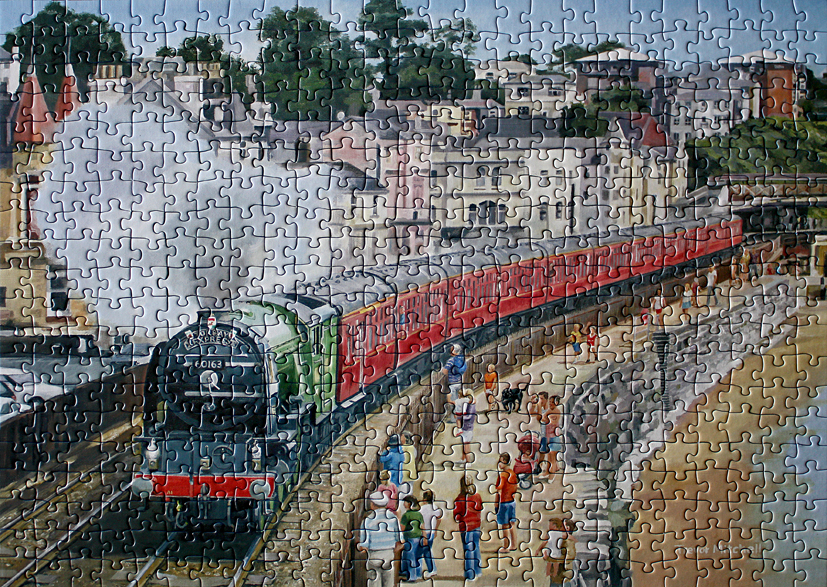
The second photograph shows the new-build A.H. Peppercorn 'A1' class 4-6-2 locomotive, No.60163 Tornado, heading a famous Great Western Railway (GWR) express. This puzzle is titled Tornado hauls the Torbay Express. The locomotive, main line tested at the end of 2008, first hauled this express in 2009.  The Torbay Express is depicted running along the sea wall at Dawlish, one of the most famous vantage points for artists/photographers on Britain's railways. The original Torbay Express was a Paddington - Torquay - Paignton service but more recently, a Bristol - Torquay - Paignton - Kingswear service, via Weston -super- Mare.


If you wish to review previous Ravensburger, steam railway jigsaw puzzles featured on this blog, just input Ravensburger into the search bar at the top of the blog and the relevant posts will be identified.

Friday, 6 April 2012

Jigsaw in Monochrome

The jigsaw described in this post, 6th April 2012, is a very unusual example.

When one considers that the steam age and monchrome photography coincided for over one hundred years it is surprising that very few jigsaw puzzles replicate black and white photographs. Although not reproduced from a particularly good, original photograph (compared with modern examples) a monochrome jigsaw in my collection, of 550 pieces, was made by  Robert Frederick Ltd., and titled The Silver Jubilee Steam Train 1935; it was issued in 2004. The photograph depicts the 'A4' class 4-6-2 locomotive, No.2509 Silver Link, heading the famous express. This engine was one of four specially designed by (Sir) Nigel Gresley in 1935 to head the express train.  A further thirty one 'A4's' were built to complete the class. Because of similarities within the grey tones this puzzle takes longer to complete than a corresponding coloured jigsaw. The small right hand side pieces are non-interlocking with each other, another problem associated with this puzzle.